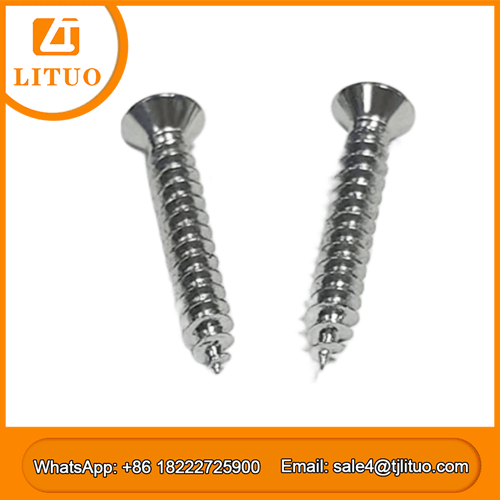
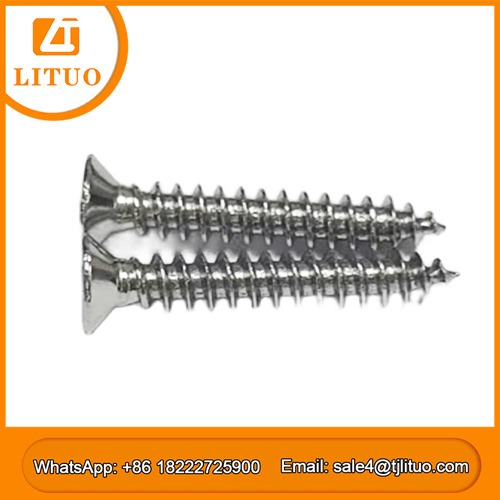
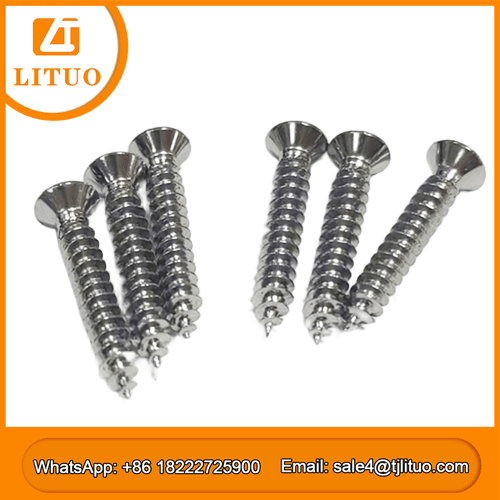
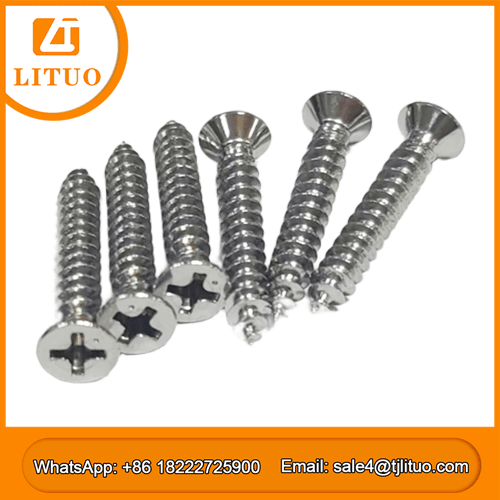
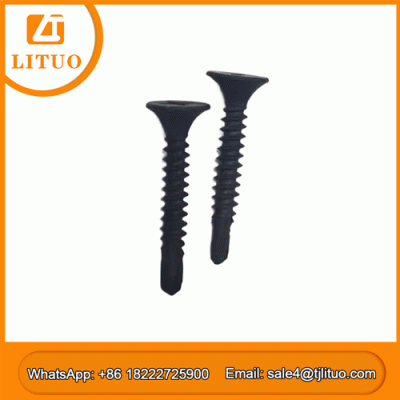
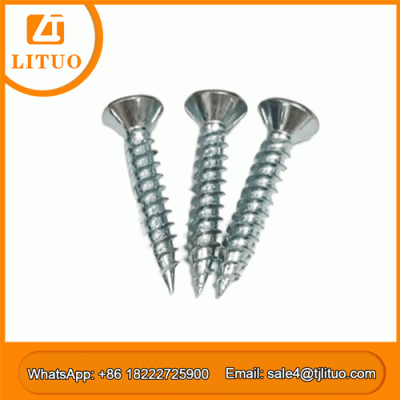
Stainless steel countersunk self-tapping screws are made of stainless steel and offer excellent rust and corrosion resistance. They feature a conical countersunk head and self-tapping capability. They require no pre-tapping and can be screwed directly into softer materials such as sheet metal, plastic, and wood to form a matching thread. After installation, the head is recessed below the surface, creating a smooth finish.
Stainless steel materials are generally 304 and 316.
A2-304 (Austenitic 304 stainless steel): The most common type, offering good resistance to atmospheric, water, and weak acid corrosion. A common choice for "food-grade" applications.
A4-316 (Austenitic 316 stainless steel): Contains molybdenum, offering even stronger corrosion resistance, especially against chloride ion corrosion (such as seawater, salt water, and chemical environments). It is more expensive.
However, it should be noted that it usually cannot penetrate thick metal directly and requires pre-drilling or use on thin sheets/soft materials.
Key Advantages: Excellent corrosion resistance: The stainless steel material makes it suitable for humid, outdoor, food contact, and chemical environments prone to corrosion, resulting in a long service life.
Aesthetically pleasing and clean: The surface is typically the original stainless steel color (matte silver-white), clean and aesthetically pleasing, with a countersunk head design that eliminates protrusions.
Self-tapping convenience: Eliminates the need for pre-tapping, resulting in high installation efficiency on thin plates and soft materials.
Strength and toughness: High-quality stainless steel screws possess good strength and a certain degree of toughness.
Typical application scenarios:
Outdoor facilities: Stainless steel railings, outdoor signage, air conditioner outdoor unit brackets (especially in coastal areas).
Food and medical equipment: Kitchen equipment, food processing machinery, medical device housings—because 304 stainless steel is a food-grade safe material.
Marine and shipbuilding equipment: Ship deck components, dock facilities (316 material is recommended).
Chemical equipment: Pipelines, instrument panels, ventilation systems requiring corrosion resistance.
Electronic products and home appliances: High-end appliance housings, internal structures of precision instruments, requiring rust prevention and aesthetics.
Decorative engineering: Curtain wall connectors, fixing of interior and exterior decorative panels, requiring a uniform appearance and rust resistance.
Precautions: Drilling directly into thick steel plates is not recommended. For metals thicker than 1-2mm, a pilot hole slightly smaller than the screw diameter is usually required before it can function as a self-tapping screw.
Strength Selection: Although corrosion resistant, its mechanical strength (especially tensile strength) may be lower than that of high-strength alloy steel screws of the same specifications. Careful calculations are necessary in applications subject to extremely high structural loads.