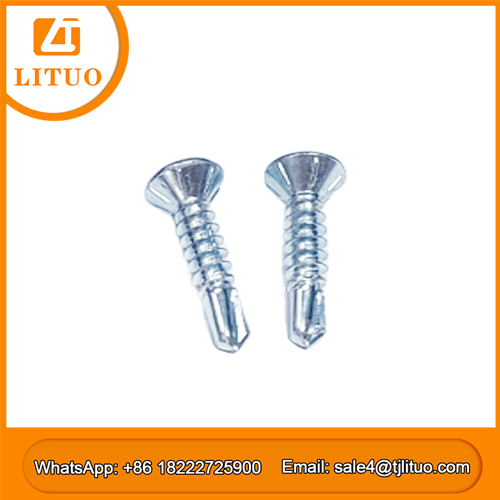
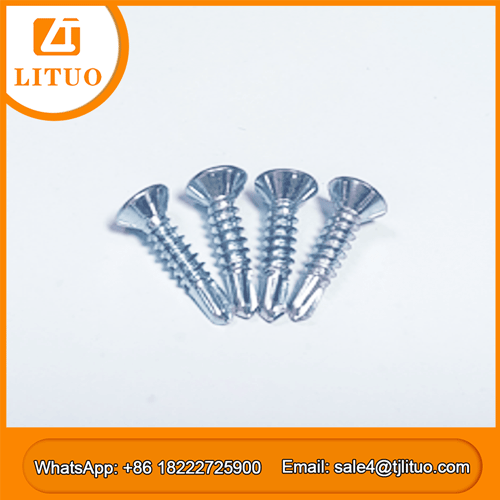
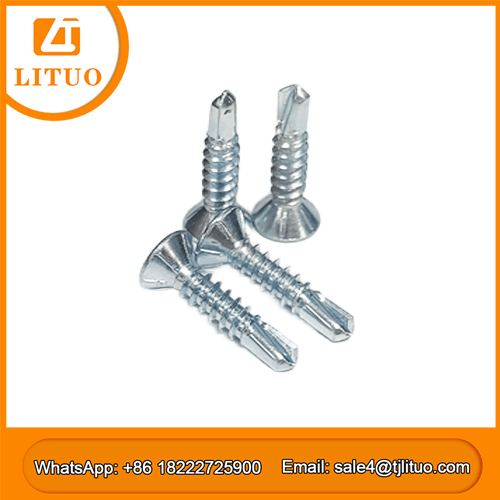
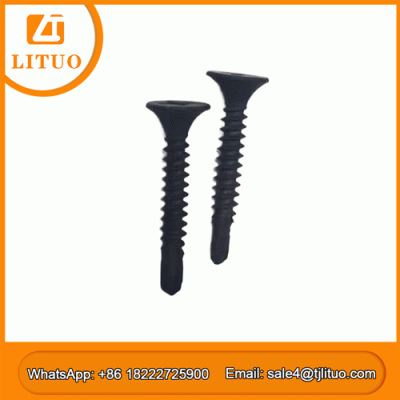
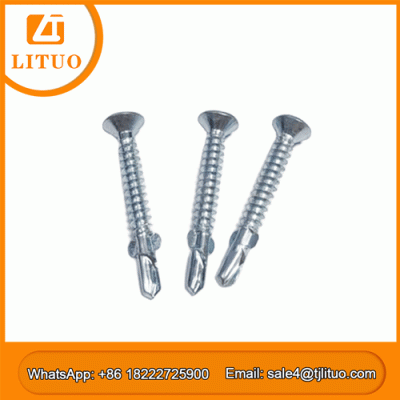
A countersunk self-drilling screw, also known as a flat-head self-drilling screw, is a screw that combines the functions of "self-tapping" (creating threads in the material), "self-drilling" (drilling a hole), and "countersunk" into one. It eliminates the need for pre-drilling and tapping, allowing for a single-step process of drilling, tapping, and tightening directly onto thin metal sheets, wood, composite materials, etc.
The countersunk head is conical in shape with a flat top surface.
After tightening, the head is completely recessed below the material surface, creating a flat mounting surface that is aesthetically pleasing and less prone to snagging.
The self-drilling point has a cutting structure at its tip, similar to a drill bit.
It is responsible for drilling a pilot hole in the material, enabling the "self-drilling" function.
The self-tapping thread is typically a type with a wide pitch and high tooth profile (such as large threads or high-low threads).
After drilling the hole, it continues to cut or press into the material to form a matching internal thread.
Commonly seen are Phillips head (PH), but hexagonal heads (with washers) and Torx heads are also available, providing the torque needed for tightening.
Working Principle:
Positioning and Drilling:The drill bit at the screw tip first contacts the material, rotating and cutting in like a drill bit to create a pilot hole.
Tapping and Tightening:As the screw is screwed in, the self-tapping thread cuts or presses against the hole wall, forming an internal thread, while simultaneously tightening the connected sheet metal.
Counterhead Placement:When the screw head contacts the material surface, its conical surface squeezes into the material or completely sinks into the pre-drilled conical hole (for hard materials), making the head flush with the surface.
Main Advantages:
High Efficiency and Time Saving:Eliminates the steps of pre-drilling, tapping, and tool changing, greatly improving installation efficiency.
Strong Connection: The self-tapping thread has a very high degree of compatibility with the screw itself, providing strong tightening force and good anti-loosening performance.
Smooth and Aesthetically Pleasing: The countersunk design ensures a smooth and flat surface after installation, without any protrusions.
Reliable Connection:Wide applicability: Particularly suitable for applications requiring the fastening of multiple layers of sheet metal (e.g., metal sheets to metal sheets, metal sheets to keel).
Main application scenarios:
Steel structure buildings: Fixing color steel sheet roofs and wall panels.
Metal frame assembly: Connecting light steel keels, C-shaped steel, and aluminum alloy frames.
Ventilation duct installation: Fixing galvanized iron sheet ducts.
Materials and surface treatment:
C1022A carbon steel is the most common, low cost, and has sufficient strength.
Stainless steel (e.g., 304, 316): Used in highly corrosive environments, such as coastal areas and chemical plants.
Surface treatment: Galvanizing is the most common, providing basic rust prevention (e.g., blue-white zinc, color zinc).
Zinc passivation (yellow zinc, green zinc, etc.): Stronger rust prevention.
Mechanical galvanizing: Thick coating, good corrosion resistance.
Dacromet has extremely high corrosion resistance and is used in harsh environments.